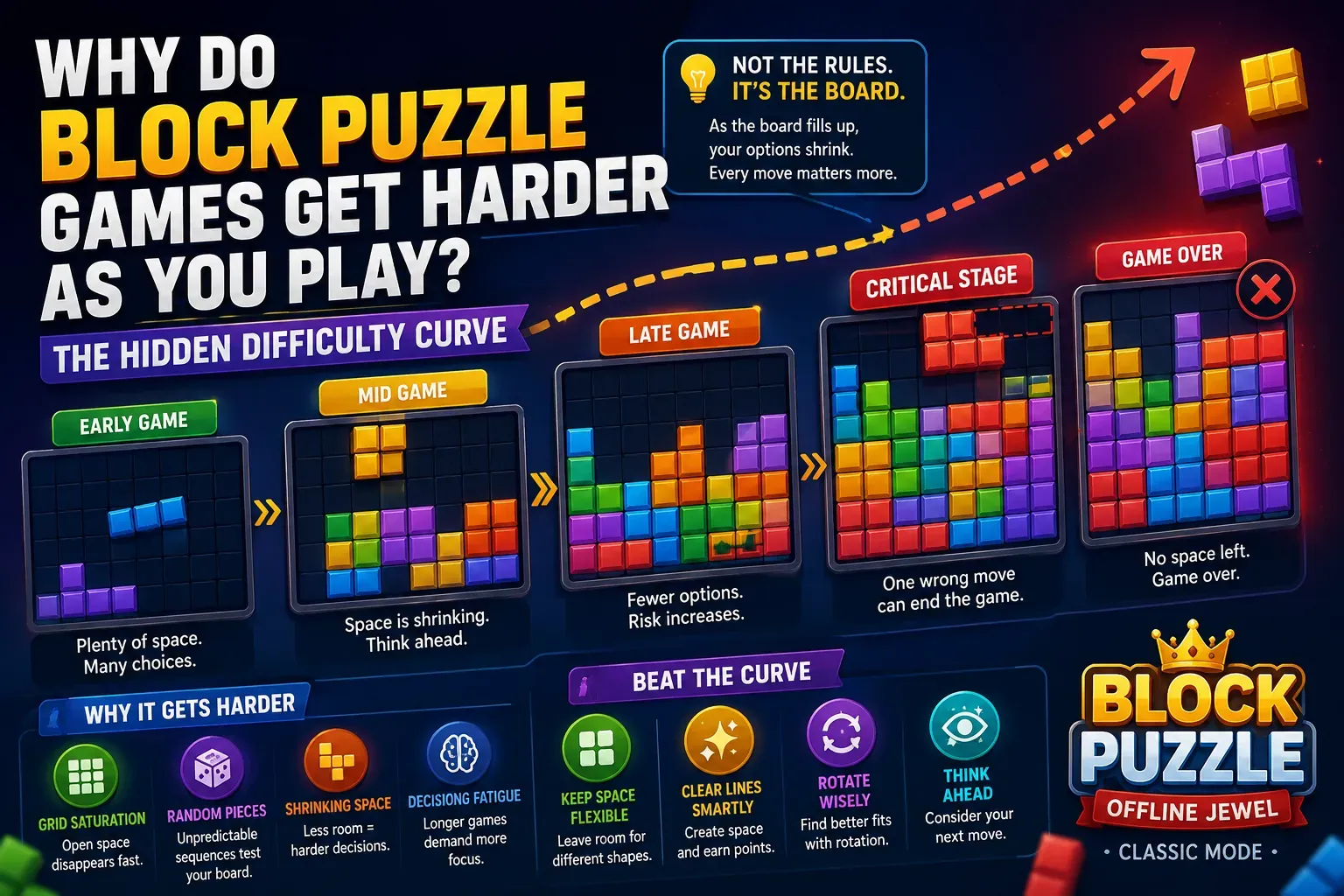
You start a block puzzle game with plenty of room. Almost every piece seems to have several possible positions, clearing a row feels easy, and the board barely demands any serious thought. Ten minutes later, the same grid feels completely different. Open spaces are harder to find, awkward pieces seem to appear at exactly the wrong time, and every placement feels like it could decide the game.
So what happened?
Did the game secretly become harder?
Sometimes it can, depending on the game's design. But in many block puzzle games, the difficulty curve is largely determined by the state of the board itself. As open space disappears and your choices become more constrained, the same simple rules produce increasingly difficult decisions.
Understanding why that happens can change the way you play.
The Short Answer: It's Not the Rules, It's the Board
Most block puzzle games feel harder over time because the board becomes increasingly constrained while new pieces continue to arrive. As empty space shrinks, fewer placements remain available, so each decision has a larger effect on future moves. Random piece sequences can make that pressure feel even stronger.
In other words, the basic rules may remain unchanged, but the number of good choices available to you keeps falling. That creates a natural difficulty curve without requiring traditional levels or increasingly powerful opponents.
How the Difficulty Curve Actually Works
The difficulty of an endless block puzzle usually comes from several mechanics working together. Grid saturation gradually reduces usable space, while the arrival of different block shapes forces you to adapt to whatever the board can currently accommodate. As the board becomes crowded, previously harmless placements can create problems several moves later. At the same time, longer sessions demand more concentration because each decision requires you to compare more possible outcomes. The result is an emergent difficulty curve: the game doesn't necessarily need to change its rules for the experience to become harder. The board changes, your available options shrink, and the mental effort required to keep playing increases.
Grid Saturation: Why Open Space Disappears Fast
Every Block Changes the Shape of Your Future Board
The easiest part of a block puzzle is usually the beginning.
The grid has large areas of uninterrupted space, so a piece can often be placed in several locations. If one position turns out to be inconvenient, there is plenty of room to recover.
That changes as the board fills.
Every block you add occupies cells that could otherwise be used by future pieces. More importantly, it changes the shape of the remaining empty space. A placement doesn't simply remove a few squares from the board; it can divide one large area into several smaller areas.
This is where the difficulty curve begins to accelerate.
A three-block piece might have dozens of possible positions on an open board. Later, the same shape may have only two or three realistic placements. A larger piece can become even more restrictive.
Partially filled rows and columns make this effect stronger. When several areas are almost complete but not quite ready to clear, they can create narrow spaces that only certain shapes can use.
The rules haven't changed.
Your available choices have changed.
That is why late-game pieces can feel dramatically harder even when they are exactly the same shapes you were placing comfortably a few minutes earlier.
Randomized Block Generation: No Real Levels Needed
Different Piece Sequences Can Create Sudden Difficulty Spikes
Many block puzzle games use some form of randomized or semi-random piece generation. The exact system varies between games, and players don't always see how the underlying selection works.
Some systems use a completely random approach, while others use variations of a "bag" system designed to distribute pieces more evenly. The important point for players is that the next pieces aren't necessarily chosen to match the exact shape of your board.
That uncertainty is part of the challenge.
Imagine your board has plenty of small gaps and you receive several large pieces in succession. None of those pieces may fit comfortably, even though the board appeared healthy moments earlier.
That can feel like the game suddenly increased its difficulty.
Usually, what's happening is more subtle: the current piece sequence has interacted badly with the board you've already built.
This is also why two games played under the same rules can feel completely different. One sequence may give you opportunities to clear several lines early, while another may force you to make difficult placements before you've had time to create enough open space.
Good block puzzle strategy therefore isn't about predicting every upcoming piece.
It's about building a board that can handle a variety of pieces.
Shrinking Safe Space and the Problem of Board Debt
Early Mistakes Can Become Expensive Much Later
One useful way to understand long block puzzle games is through the idea of board debt.
Board debt is the future problem created by a placement that seems harmless right now.
Suppose you place a block in a slightly awkward position because it fits and doesn't immediately cause trouble. Nothing bad happens. You continue playing.
Several moves later, however, a large piece arrives and needs the exact area you previously made difficult to use.
Now you have a problem.
That original placement created a cost, but you didn't pay it immediately.
This is why the final few moves before a game ends can feel so sudden. The board may have been accumulating small inefficiencies for ten or twenty turns. Once enough of them stack up, the number of workable positions collapses quickly.
The player experiences the ending as a sudden failure.
The board experienced it as a gradual buildup.
Thinking about board debt encourages a different approach: don't judge a placement only by whether it works now. Consider whether it leaves useful space for the pieces that could arrive later.
Decision Fatigue: The Player-Side Difficulty Curve
Longer Sessions Can Make the Same Board Feel Harder
The difficulty curve isn't entirely inside the game.
It's also inside the player.
At the beginning of a session, you're usually fresh. You can examine the board, compare several placements, and recognize patterns quickly.
After playing for a longer period, sustained decision-making can become more demanding.
A crowded board requires you to consider more consequences. You may need to compare several possible placements, think about future shapes, identify potential line clears, and avoid creating awkward gaps—all while remembering what you just changed.
That's a lot of visual and mental processing.
This doesn't mean a longer session automatically makes you worse. Practice can improve familiarity with shapes and board patterns. But fatigue can make it harder to maintain the same level of attention.
It's one reason a short, focused session can sometimes produce better decisions than an extended session where you're playing on autopilot.
For a game designed around spatial reasoning and quick decision-making, the player's attention becomes part of the challenge.
Classic Mode vs. Levels Mode: Two Different Difficulty Curves
Classic and Levels Modes Challenge You in Different Ways
Not every block puzzle experience creates difficulty in exactly the same way.
In Classic Mode, the challenge is primarily open-ended. The goal is to keep playing, clearing lines, managing space, and improving your score for as long as the board allows. There is no countdown forcing you to make moves quickly, so the difficulty comes mainly from the evolving board and the pieces you receive.
That creates an emergent difficulty curve. The longer you survive, the more constrained the board can become.
Levels Mode works differently. Instead of asking you to survive indefinitely, it provides structured challenges with defined goals and progression. The difficulty is therefore more deliberately designed around what each level asks you to accomplish.
Neither approach is inherently better.
Classic Mode suits players who enjoy chasing high scores and seeing how long they can keep the board alive. Levels Mode is better for players who prefer clear objectives and a sense of progression.
Understanding this difference also explains why the two modes can feel difficult for completely different reasons.
How to Beat the Difficulty Curve
Protect Flexibility Before the Board Becomes Crowded
You can't remove the difficulty curve completely, but you can make it much easier to handle.
The first strategy is to protect flexible space.
Don't fill every convenient opening simply because a piece fits. A large connected area is often more valuable than several tiny pockets because it can accommodate more shapes.
Clear Lines When They Help the Board
Scoring is important, but line clearing also has a practical purpose: it creates space.
If a placement completes multiple lines while keeping the remaining board flexible, that's particularly valuable. The game's own mechanics reward clearing multiple lines in a single move with bonus points, so looking for efficient clears can improve both space and scoring.
Don't Build Around One Perfect Shape
If you create a board that only works for one particular block, you're relying too heavily on what appears next.
Instead, leave enough variety in your open areas to accommodate different shapes.
Rotate Before You Commit
Rotation can turn an awkward piece into a useful one. Block Puzzle Offline Jewel specifically includes block rotation as part of its gameplay, allowing players to change a piece's orientation before placing it.
Before deciding that a piece doesn't fit, consider whether another orientation creates a better option.
Think About the Next Move
You don't need to predict ten turns ahead.
Even looking one move beyond the current placement can help. Ask:
"If I put this here, what kind of space will I have afterward?"
That question is often more useful than simply asking where the piece fits now.
For more practical gameplay advice, you can connect this article with your site's 15 Expert Tips article as an internal resource.
Why the Difficulty Feels Like It Appears Out of Nowhere
The most deceptive part of a block puzzle difficulty curve is that it usually doesn't rise smoothly.
You might have ten comfortable moves followed by three extremely difficult ones.
That's because difficulty depends on the interaction between your board and the incoming pieces.
A single line clear can suddenly open a large section of the grid and make the next several moves easy again.
Conversely, one poorly placed large piece can divide an open area and make the next few turns dramatically harder.
So the curve isn't a straight line.
It's more like a series of waves.
Board condition → piece sequence → placement → new board condition
That cycle repeats throughout the game.
The better you become at managing the board, the more often you can use each cycle to create opportunities instead of problems.
Frequently Asked Questions
Do block puzzle games actually get harder, or does it just feel that way?
Both can happen. In many endless block puzzle games, difficulty emerges because the board becomes more crowded and usable space decreases. Longer sessions can also increase mental fatigue, making complex positions feel harder to evaluate.
Is the difficulty in block puzzle games random or programmed?
It depends on the game. Piece generation may use random or semi-random systems, while structured modes can use intentionally designed goals and challenges. The difficulty players experience often comes from the interaction between piece generation and the current board.
Why do I always lose around the same score?
Repeatedly losing around the same score can indicate that your board-management habits are creating similar problems at roughly the same stage. Look at your final boards and identify recurring patterns such as isolated gaps, uneven stacks, or a lack of space for larger pieces.
Does playing longer make you better at block puzzle games?
Practice can improve your familiarity with shapes, spatial patterns, and decision-making, but longer sessions don't automatically produce better play. Focused practice and reviewing mistakes can be more useful than simply playing for longer periods.
Final Thoughts
The block puzzle difficulty curve is often less mysterious than it appears. In many games, the rules stay simple while the board becomes progressively less forgiving. Grid saturation, piece sequences, shrinking flexible space, and player fatigue combine to make later moves harder without requiring a traditional difficulty system.
Once you understand that, you can change your strategy.
Protect open space, clear lines when they improve the board, rotate pieces when useful, and think about what each placement leaves behind. Then put those ideas to work in Classic Mode or take on the structured challenges of Levels Mode in Block Puzzle Offline Jewel.