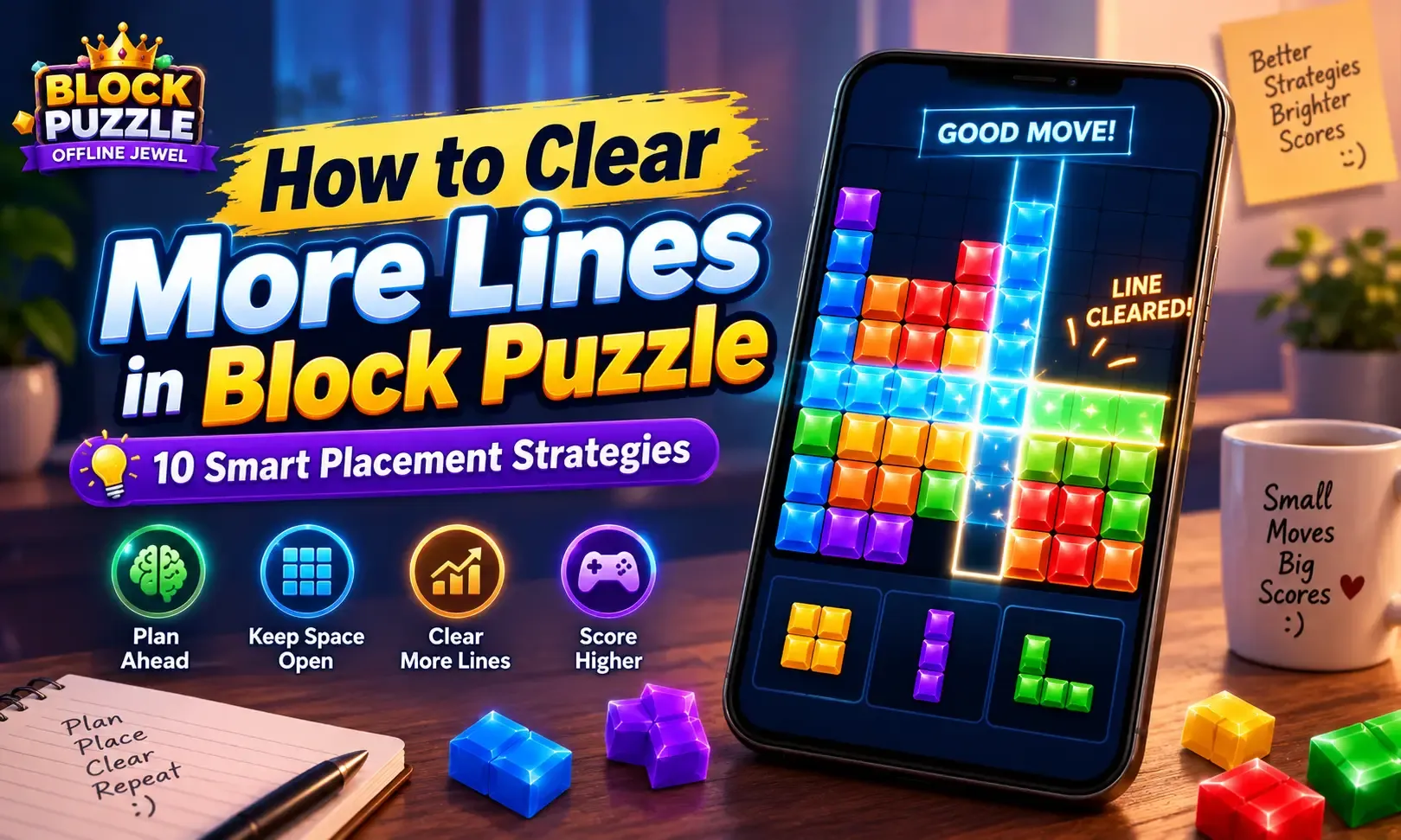
How to Clear More Lines in Block Puzzle: 10 Smart Placement Strategies
Getting started with Block Puzzle is easy. The challenge is keeping the board open long enough to clear a lot of lines and build a high score.
At first, it can be tempting to place each block wherever it fits. That usually works for a few moves. Eventually, however, awkward gaps begin appearing, large pieces become difficult to place, and the board fills up faster than expected.
The difference between an average game and a great one often comes down to where you place each block.
You don't need complicated techniques to improve. A few smart placement habits can help you create more clearing opportunities, avoid unnecessary gaps, and keep the board manageable for longer.
Here are 10 practical Block Puzzle placement strategies you can start using immediately.
What Is the Best Way to Clear More Lines in Block Puzzle?
The best way to clear more lines is to think about your next few moves instead of placing each block individually. Keep useful areas of the board open, avoid creating isolated gaps, prioritize moves that clear lines without damaging the board, and use larger or awkward shapes carefully.
A good Block Puzzle player isn't simply looking for somewhere to put the current piece. They're also thinking about what the board will look like afterward.
That small change in thinking can make a major difference.
1. Look at All Available Blocks Before Making a Move
One of the easiest mistakes is immediately placing the first block you see.
Instead, pause for a moment.
Look at all the available shapes and consider how they might interact with the current board.
Ask yourself:
- Which block fits naturally?
- Which placement could complete a line?
- Which piece is difficult to use later?
- Where will this move leave useful open space?
- Could another block create a better clearing opportunity?
You don't need to predict the entire game. Even looking one or two moves ahead can prevent poor placements.
This is especially important when several pieces have very different shapes.
Quick rule: Don't ask only, "Where can this block fit?" Ask, "Where can this block fit without making my next move harder?"
2. Keep the Center of the Board Flexible
A crowded center can quickly make the rest of the board difficult to manage.
Whenever possible, avoid filling every available central space simply because a piece fits there.
A flexible area gives you more options for future pieces.
For example, if you have a large L-shaped piece later, you may need a particular combination of empty spaces to accommodate it. Filling those spaces too early can leave you with nowhere useful to place the piece.
You don't necessarily need to keep the exact center empty throughout the game. The goal is simply to avoid turning the middle of the board into an inflexible wall of blocks.
Think of empty space as a resource.
Don't waste it.
3. Build Toward Line Clears
A line clear should usually be part of your placement plan rather than an accidental result.
When a row or column is nearly complete, consider which available piece could finish it.
But don't rush into a line clear if doing so creates a terrible board afterward.
A useful question is:
What does the board look like after the line disappears?
Clearing one line is helpful.
Clearing one line while opening several useful spaces can be much better.
This is why experienced players often think beyond the immediate reward. A placement that looks slightly less impressive can create a much stronger board for the next several moves.
4. Avoid Creating Small, Isolated Gaps
Small empty spaces can become surprisingly dangerous.
If a single-cell gap is surrounded by blocks, many pieces may be unable to reach it. You can end up with an empty square that remains useless while the playable area around it continues shrinking.
Try to build shapes that leave larger, connected areas of empty space whenever possible.
Connected spaces are valuable because more block shapes can fit into them.
Compare these two situations:
Situation A: Several isolated one-cell gaps surrounded by blocks.
Situation B: One larger open area where multiple shapes can be placed.
Situation B generally gives you more flexibility.
This doesn't mean you should never create a small gap. Sometimes it's unavoidable. The key is avoiding a board full of them.
5. Don't Chase Every Immediate Line Clear
Clearing a line feels good—and that's exactly why it can be tempting to prioritize every possible clear.
But not every line clear is worth taking immediately.
Imagine you can complete a row with one block. Doing so removes the row but leaves several awkward gaps around the board.
Alternatively, you could place the same block elsewhere, keep the row partially filled, and create a better setup for your next pieces.
The second option may produce more clears later.
Think of Block Puzzle as a balance between short-term rewards and long-term board control.
A line clear is useful.
A line clear that improves your board is even better.
6. Place Large Blocks Before They Become a Problem
Large pieces can be difficult to fit once the board becomes crowded.
That's why you should pay attention whenever a larger shape appears.
If there's a good location for it, don't automatically save it for later.
The board may become much less suitable for that piece after only a few moves.
This is particularly important when a large block requires several adjacent empty spaces.
Before placing smaller pieces into those spaces, consider whether the larger piece could use them more effectively.
A simple strategy is:
Use difficult pieces when the board gives you a good opportunity, and save flexible pieces for later.
Smaller, simple shapes can often fit into spaces that larger pieces cannot.
7. Use Corners Carefully
Corners can be useful—but they can also become traps.
A block placed in a corner may seem harmless because it leaves the rest of the board open. However, depending on its shape, it can create an awkward structure that makes future placements difficult.
Before using a corner, look at the surrounding spaces.
Can the area still accommodate different shapes?
Does the placement help complete a row or column?
Could the same block be used more effectively somewhere else?
Corners are not automatically good or bad. Their value depends on the shape of the block and the current board.
The important thing is to place with purpose rather than treating empty corners as convenient dumping grounds.
8. Think About Both Rows and Columns
A common beginner habit is focusing only on horizontal lines.
But Block Puzzle gives you another valuable clearing direction: vertical lines.
When planning a placement, look at both.
A single block may contribute toward completing a row, a column, or potentially both.
This becomes especially useful when several lines are close to completion.
Before placing a piece, scan the board horizontally and vertically.
Ask:
Can this placement help me complete more than one line?
If the answer is yes, you may have found a particularly valuable move.
9. Create Opportunities for Multiple Clears
One of the best ways to improve your score is to look for placements that can lead to multiple line clears.
Instead of thinking:
"How do I clear one line?"
Try thinking:
"How can I arrange the board so that one placement helps clear several lines?"
This requires more planning, but it can produce much better results.
For example, you might have a nearly complete row and a nearly complete column that share an empty area. A carefully selected block can potentially contribute to both.
The key is not to force a combo every time.
If creating a multiple-clear opportunity requires several risky placements, it may be better to take a safer single clear.
Good strategy is about creating opportunities—not forcing them.
10. Always Think About the Board After the Move
This may be the most important strategy on the entire list.
Don't judge a move only by what happens immediately.
Judge it by what it creates.
After considering a placement, quickly visualize the resulting board:
- How much open space remains?
- Are there isolated gaps?
- Can large pieces still fit?
- Are rows or columns close to completion?
- Did you block a useful area?
- Does the board have several possible next moves?
This habit separates random placement from strategic placement.
You don't need to calculate ten moves ahead. Just develop the habit of looking at the next position rather than the current one.
Over time, you'll start recognizing good placements almost automatically.
Common Block Puzzle Placement Mistakes
Even when you understand the basic strategies, several habits can hold your score back.
Filling Empty Spaces Just Because You Can
A block fitting somewhere doesn't necessarily mean it's the best placement.
Ignoring Large Pieces
Saving difficult shapes for too long can leave you with no suitable space later.
Focusing Only on the Current Score
A quick line clear isn't always worth damaging your board.
Creating Too Many Small Gaps
Scattered gaps reduce the number of shapes you can place effectively.
Playing Too Quickly
Block Puzzle doesn't require lightning-fast reactions. Take a moment to inspect the board.
Forgetting About Columns
Looking only at horizontal lines means you'll miss potential clearing opportunities.
A Simple Strategy for Beginners
If you're new to Block Puzzle, don't try to remember all 10 strategies at once.
Start with these five rules:
- Look at all available pieces before placing one.
- Keep useful open space available.
- Avoid isolated gaps whenever possible.
- Think about both rows and columns.
- Consider what the board will look like after every move.
Once these habits become natural, start working on multiple-line opportunities and more advanced board management.
How to Get Better at Block Puzzle
Improvement mostly comes from recognizing patterns.
The more you play, the easier it becomes to identify:
- Dangerous gaps
- Useful open spaces
- Good clearing positions
- Difficult pieces
- Potential multiple-line clears
- Placements that will restrict future moves
Don't worry about making every move perfectly.
Even a failed game can teach you something.
When the board fills up, look back at the final few moves. Ask yourself where your available space started disappearing. Often, the problem didn't begin with the final block—it started several moves earlier.
That observation can help you make better decisions in your next game.
Why Strategic Placement Makes Block Puzzle So Enjoyable
Block Puzzle is easy to understand because the basic objective is simple: place blocks and clear lines.
But underneath that simplicity is a constant decision-making challenge.
Every new piece changes the possibilities on the board.
A move that looks perfect now might create a problem later. A seemingly ordinary placement might open the exact space you need for your next piece.
That's what keeps the game interesting.
You aren't simply reacting to blocks.
You're managing space.
And the better you become at managing that space, the longer you can survive and the more lines you can clear.
Try These Strategies in Block Puzzle: Offline Jewel
If you enjoy relaxing puzzle games but still want something that rewards careful thinking, Block Puzzle: Offline Jewel offers a simple way to put these strategies into practice.
You can focus on placing blocks efficiently, creating line-clearing opportunities, managing your available space, and gradually improving your high score.
The best part is that you don't need an internet connection to enjoy the puzzle experience. It's well suited to short breaks, travel, commutes, or those moments when you simply want to put your phone on airplane mode and play.
Start with one goal: make every placement count.
Then see how much longer you can keep the board open.
Frequently Asked Questions
How do you clear more lines in Block Puzzle?
To clear more lines, plan placements before making them, keep open areas available, avoid isolated gaps, and look for opportunities to complete rows and columns with the same placement.
What is the best Block Puzzle strategy?
The most useful strategy is to manage your empty space carefully. Don't focus only on clearing the current line; consider how each placement affects your future moves.
Should you clear a line whenever possible?
Not always. An immediate line clear can sometimes leave a difficult board. If waiting creates more useful space or a better clearing opportunity, the safer placement may be more valuable.
How do you avoid getting stuck in Block Puzzle?
Avoid filling the board unevenly, creating isolated gaps, or using all your flexible spaces too early. Keep enough open space for different block shapes.
Should you place large blocks first?
When a large block has a good available position, placing it before the board becomes crowded can be a smart choice. Smaller and simpler pieces are generally easier to fit later.
How can I improve my Block Puzzle score?
Focus on board management rather than individual moves. Look for efficient line clears, preserve flexible spaces, and plan at least one move ahead. With practice, you'll recognize stronger placements more quickly.
Is Block Puzzle difficult to learn?
The basic rules are very easy to understand, but achieving consistently high scores requires planning and good space management. That's what gives the game its accessible-but-challenging quality.
Final Thoughts
Clearing more lines in Block Puzzle isn't about moving faster. It's about placing smarter.
The strongest players learn to see the board as a collection of possibilities rather than simply a collection of empty squares. They preserve useful space, avoid unnecessary gaps, consider both rows and columns, manage difficult pieces, and think about what each move creates.
You don't have to master all 10 strategies immediately.
Start by slowing down.
Look at your available pieces.
Find the placement that gives you the most options.
Then repeat.
With practice, you'll begin to recognize patterns that weren't obvious before—and those better decisions can turn an ordinary Block Puzzle session into a much higher-scoring game.
Place carefully. Clear strategically. Keep the board open—and keep chasing that high score.