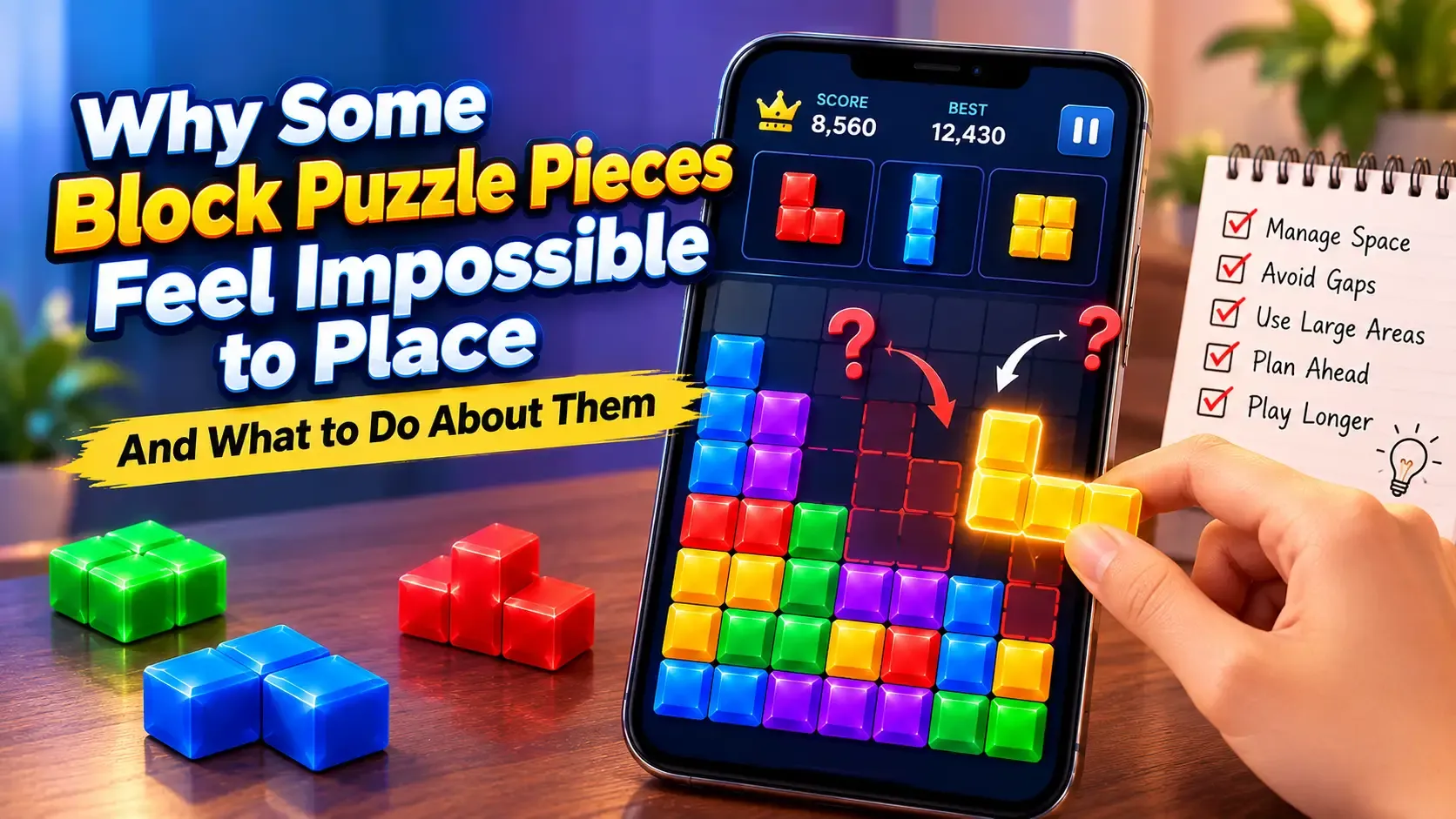
A Block Puzzle game can feel completely under control one moment and suddenly turn into a problem you can't solve.
You have several empty spaces. You still have moves available. Then a large L-shaped piece, long bar, square, or another awkward shape appears—and somehow none of those empty spaces seem useful anymore.
It's easy to think the game has simply given you an impossible piece.
Usually, that's not quite what is happening.
In most cases, the problem started a few moves earlier. The board gradually lost its flexible spaces, small gaps became isolated, or an area that looked empty stopped being large enough for the pieces you needed.
That's what makes block puzzle games interesting. The challenge isn't simply finding an empty square. It's managing usable space.
This guide explains why some Block Puzzle pieces feel impossible to place, what makes certain shapes difficult, and what you can do before the board reaches that point.
Why Do Some Block Puzzle Pieces Feel Impossible to Place?
Some Block Puzzle pieces feel impossible to place because the available empty spaces don't match the shape, size, and orientation of the current piece.
An empty area isn't automatically useful.
A large piece may need several connected cells. A long piece needs a clear row or column. A square requires a compact open area. A more unusual shape may need a specific arrangement of empty spaces.
If your board has plenty of empty cells but they're scattered across different locations, the current piece may have nowhere to go.
This is why space quality matters more than the total amount of empty space.
The Real Problem Usually Starts Before the Difficult Piece Appears
When a difficult block arrives, it's tempting to blame the piece.
But look at the board differently.
The piece didn't create the problem. It revealed it.
A board can slowly become less flexible through several ordinary-looking moves:
- Filling a large open area too early
- Creating isolated one-cell gaps
- Building too heavily on one side
- Saving difficult shapes for too long
- Clearing lines without considering the resulting space
- Using a flexible area for a piece that could have fit elsewhere
None of these decisions necessarily ends the game immediately.
Their effect accumulates.
Eventually, you receive a piece that needs a type of space you no longer have.
That's when it feels impossible.
Empty Space Isn't Always Usable Space
This is one of the most important concepts for improving at Block Puzzle.
Imagine your board has 15 empty cells.
That sounds like plenty.
But suppose those 15 cells are spread across tiny gaps:
- Three isolated cells in one corner
- Two spaces between existing blocks
- Four cells along an edge
- Several disconnected spaces around the middle
You may still have 15 empty cells, but a large block might not fit anywhere.
Now imagine another board with only 10 empty cells, but most of them form one connected area.
That board could give you more practical options.
So when looking at your board, don't ask:
"How many empty spaces do I have?"
Ask:
"How many useful spaces do I have?"
That question can change the way you place every block.
Why Large Block Puzzle Pieces Are Often the Hardest
Large pieces naturally have fewer placement options.
A small block can often fit into several different areas.
A large shape needs more room and usually needs that room to be connected in a particular way.
This becomes especially important when the board starts filling up.
A large piece may require:
- A wide open area
- Several connected cells
- A clear section along an edge
- A specific corner arrangement
- Enough room around existing blocks
If those spaces disappear, the piece becomes difficult to use.
That's why you shouldn't always use your biggest open area simply because it is available.
Sometimes that space is more valuable as future insurance against a difficult piece.
Why Small Gaps Can Become a Big Problem
Small gaps are easy to ignore.
One empty cell between two blocks doesn't seem dangerous.
But if it can't be filled by any future piece, it becomes dead space.
Several small gaps can have an even bigger effect.
They can divide the board into disconnected sections and make your remaining empty cells much less useful.
For example, a large open area might allow several different shapes to fit.
Place a few blocks carelessly inside it, however, and that same area can turn into:
- A narrow corridor
- A collection of single-cell gaps
- A pocket that only accepts one specific shape
- An area too small for your larger pieces
The board hasn't necessarily lost all its empty space.
It has lost flexibility.
What Should You Do When a Block Doesn't Seem to Fit?
When a piece appears impossible to place, don't immediately make a random move.
Pause and scan the entire board.
First, check every corner and edge
Players often focus on the center and overlook spaces around the outside of the board.
Then look for connected empty areas
A piece may not fit in a small gap but could fit perfectly into a larger open section.
Check whether clearing a line changes the situation
If the current board has a nearly completed row or column, clearing it could create the space you need.
Consider other available pieces
If your game gives you multiple pieces to choose from, don't automatically use the easiest one first.
The awkward piece may need priority.
Look at the board after the placement
Even if the piece technically fits, ask whether putting it there will make your next move worse.
The goal isn't simply to survive the current piece.
It's to keep the board playable afterward.
Use Difficult Pieces Before the Board Gets Crowded
One of the most useful habits in Block Puzzle is recognizing which pieces have limited placement options.
If you have a large or unusual shape and a spacious board, you may have a good opportunity to place it.
If you ignore it and fill that space with smaller pieces, the same shape could become much harder later.
This leads to a simple strategy:
Use restrictive pieces while you still have suitable space.
Flexible pieces can often wait.
Difficult pieces may not.
That doesn't mean every large piece should be placed immediately. The correct location still matters.
The point is to recognize that different pieces have different levels of flexibility.
Don't Fill the Center Just Because It's Empty
The center of the board often looks like the obvious place to build.
It's open.
It's convenient.
And placing blocks there can feel natural.
But the center is also valuable because it can accommodate many different shapes.
If you fill it too quickly, you may reduce your future options.
Instead, consider whether the current piece could fit safely toward an edge or into another suitable area while keeping the central space flexible.
You don't need to keep the center empty forever.
Just avoid treating every empty central area as disposable.
Corners Can Help—or Trap You
Corners are another area that deserves attention.
A corner can be useful for certain shapes, especially when you can place a piece there without restricting the rest of the board.
But a corner can also become difficult if you fill the surrounding cells in an awkward pattern.
Before placing a piece into a corner, ask:
What other shapes could still fit here afterward?
If the answer is "almost none," you may be creating a future problem.
Good board management isn't about avoiding corners.
It's about using them deliberately.
What If You Have Several Pieces and Only One Seems to Fit?
This is where prioritization becomes important.
Suppose you have three available pieces:
- A small square
- A simple line
- A large irregular shape
The small square might fit almost anywhere.
The line may fit in several open rows or columns.
The irregular shape may have only one realistic location.
In that situation, the difficult piece deserves your attention first.
Ask:
"Which piece has the fewest options?"
That piece may determine your next move.
This is a useful principle not only for Block Puzzle but for many spatial puzzle games:
The most flexible piece gives you options. The least flexible piece creates constraints.
Don't Sacrifice the Whole Board for One Difficult Piece
There is an important exception.
You shouldn't destroy an otherwise healthy board simply to force one difficult block into a space.
Sometimes a piece genuinely doesn't have a good placement.
If using it requires creating several isolated gaps or completely blocking your future options, the problem may be unavoidable.
The key is recognizing the difference between:
"This piece doesn't fit right now."
and
"I can force this piece in, but it will probably ruin the board."
The second option isn't necessarily a solution.
Sometimes the better strategy is to make the best possible move with the current situation and focus on preserving whatever useful space remains.
How Line Clearing Can Rescue a Difficult Board
Line clearing isn't only about scoring.
It can also be a way to reshape the board.
Suppose a row is nearly complete and removing it would open a large section of the grid.
That clear could transform an awkward board into a flexible one.
This is why you should look at potential line clears in terms of their consequences.
Don't only think:
"How many points will I get?"
Also think:
"What space will this clear create?"
A single line clear that opens a large area can be strategically more valuable than a move that produces a bigger immediate score but leaves the board crowded.
Why Playing Too Quickly Makes Difficult Pieces Harder
Block Puzzle doesn't reward you simply for placing pieces quickly.
If you rush, you're more likely to:
- Miss a better placement
- Ignore a nearly completed line
- Overlook a corner
- Create an unnecessary gap
- Use valuable open space too early
- Forget about your other available pieces
Taking a few seconds to inspect the board can prevent mistakes that take several moves to recover from.
This is especially important when a piece looks difficult.
Instead of thinking:
"This piece doesn't fit."
Think:
"What have I overlooked?"
That small pause can reveal a placement you didn't notice initially.
A Simple Recovery Method for a Crowded Board
If your board is already getting messy, try this five-step recovery process.
1. Stop filling random gaps
Don't place a block just because it technically fits.
2. Find your largest connected empty area
This is usually your most valuable remaining resource.
3. Identify the most restrictive piece
Figure out which available shape has the fewest realistic locations.
4. Look for a line clear
A completed row or column may give you the space you need.
5. Protect the board after the recovery move
Don't immediately fill the newly created space without thinking about the next piece.
Recovery is about restoring flexibility—not simply buying one extra move.
How Beginners Can Prevent "Impossible" Pieces
You don't have to wait until the board becomes difficult.
Build a few habits from the beginning.
Keep some large open areas
Don't divide the entire board into small sections too early.
Avoid unnecessary isolated gaps
A gap that cannot accommodate future shapes isn't useful space.
Watch the shape of your board
If one side becomes heavily crowded, future pieces may become harder to place.
Think about your difficult pieces
When you see a large or unusual shape, start considering where it could go.
Don't chase every immediate clear
Sometimes preserving space is more valuable than clearing one line.
Look at the board after every move
Your placement is not finished when the block lands. That's when the next decision begins.
How to Get Better at Placing Difficult Block Puzzle Pieces
Improvement comes largely from learning to recognize patterns.
During your next few games, pay attention to why a piece becomes difficult.
When you eventually have a piece that doesn't seem to fit, don't just restart.
Look at the board and ask:
When did my useful space disappear?
Maybe you filled a large area too early.
Maybe several isolated gaps appeared.
Maybe you kept building on one side.
Maybe you ignored a difficult piece earlier.
That kind of reflection is more useful than simply trying to play faster.
Over time, you'll start noticing these situations before they become serious problems.
Block Puzzle Is Really a Game About Space
The basic rule of Block Puzzle is simple: place pieces and clear lines.
But the deeper challenge is space management.
Every block you place changes the geometry of the board.
Every line you clear changes it again.
A piece that seems impossible may simply be exposing a board that has become too restrictive.
Once you understand that, the game becomes less about luck and more about decision-making.
You start looking at empty areas differently.
You stop seeing a gap as just a gap.
You start asking whether that gap is useful.
That is the shift that can make you a better player.
Why Block Puzzle: Offline Jewel Is Easy to Pick Up but Harder to Master
Block Puzzle: Offline Jewel is built around the familiar block-placement concept: arrange pieces on the grid, clear lines, and keep the board going as long as possible.
That simplicity makes it easy to start playing, but the board still gives you plenty of decisions to make.
Where should you place the current piece?
Should you clear a line now?
Should you preserve a larger area?
Can you fit the next difficult shape?
Those decisions are what turn a simple block puzzle into a game of planning and spatial awareness.
And because it's an offline puzzle experience, you can practice those decisions during a quick break, while traveling, or whenever you want a game that doesn't depend on a constant connection.
Frequently Asked Questions
Why do some Block Puzzle pieces not fit anywhere?
A piece may not fit because the remaining empty spaces don't match its shape and size. This often happens when the board has been divided into small or isolated gaps.
How do you place difficult blocks in Block Puzzle?
Look across the entire board instead of focusing on the first available gap. Check corners, edges, connected open spaces, and potential line clears before deciding where to place the piece.
Should I save large blocks for later?
Not necessarily. Large or unusual pieces often have fewer placement options, so using them while you still have suitable space can prevent problems later.
Is empty space always good in Block Puzzle?
No. Empty space is useful only when it can accommodate future pieces. Several isolated gaps may be much less valuable than one connected open area.
How can I avoid getting stuck in Block Puzzle?
Maintain flexible open areas, avoid unnecessary gaps, consider difficult pieces before the board becomes crowded, and think about how every placement affects your next moves.
Should I clear a line whenever I can?
Not always. A line clear can be useful, but if it creates awkward spaces or destroys your board's flexibility, another placement may be better.
How do I recover when my Block Puzzle board is almost full?
Look for the largest connected open area, identify any possible line clear, prioritize the most restrictive available piece, and avoid making random placements that further divide your remaining space.
Final Thoughts
Some Block Puzzle pieces really can feel impossible.
But often, the piece isn't the real problem.
The problem is the space left behind by your earlier decisions.
A board filled with isolated gaps can make even ordinary shapes difficult. A board with fewer blocks but larger connected areas can remain surprisingly playable.
That's why good Block Puzzle strategy isn't simply about clearing as many lines as possible.
It's about protecting your future options.
Keep useful space open. Think about difficult pieces before the board becomes crowded. Look beyond the immediate line clear. Use corners carefully, avoid dead gaps, and give yourself time to examine the entire board before placing a piece.
Eventually, you'll start seeing the warning signs earlier.
And when that supposedly "impossible" block appears, you'll be much more likely to know exactly what to do with it.