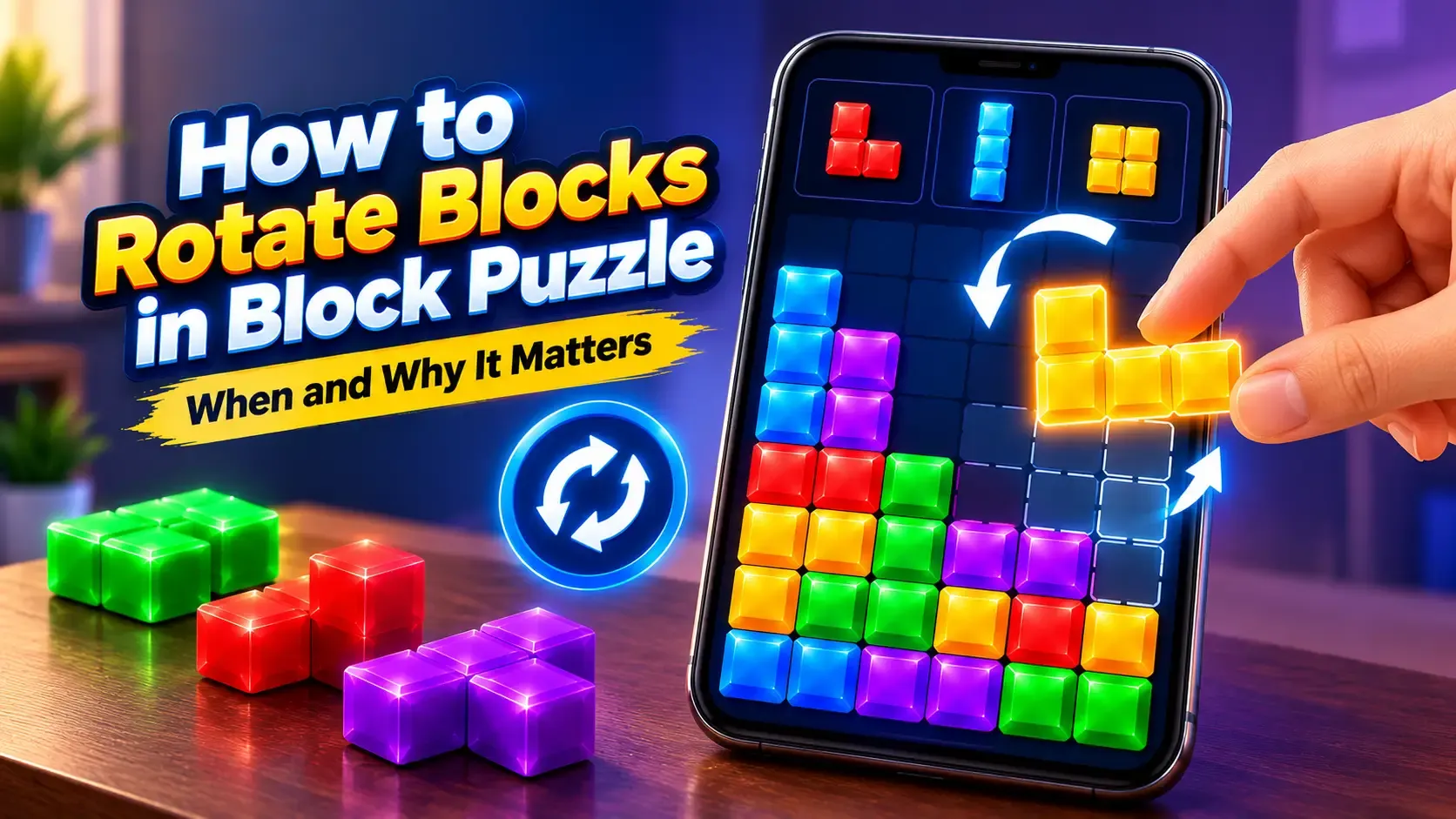
Rotating a block can look like a small move, but in a Block Puzzle game, changing the orientation of a piece can completely change where it fits.
A shape that seems useless in one position may fit perfectly after a quick rotation. The right angle can help complete a row, fill a difficult space, or prevent you from creating an awkward gap.
But rotation is not about turning every block just because you can.
The real skill is knowing when rotation improves your board and when it makes your next moves harder.
In Block Puzzle: Offline Jewel, you can rotate blocks before placing them, giving you another way to think about each move. The game also lets you drag blocks onto the grid, complete full rows or columns, and keep the board open as long as possible. Block Puzzle Offline Jewel
This guide explains how to use rotation more effectively, especially when a piece looks difficult to place.
What Does Rotating a Block Do in Block Puzzle?
Rotating a block changes its orientation so that the same shape can fit into different spaces on the board.
For example, an L-shaped piece may not fit into an open area when it is facing one direction. Rotate it, and the same piece may fit into a corner or complete part of a nearly finished line.
Rotation therefore gives you more placement possibilities without changing the actual piece.
Instead of asking only:
"Where can this block fit?"
ask:
"Which orientation gives this block the best placement?"
That small change in thinking can help you make better decisions.
When Should You Rotate a Block?
You should rotate a block when changing its orientation creates a more useful placement than the original position.
Good reasons to rotate include:
- Completing a nearly finished row
- Completing a nearly finished column
- Filling a difficult open area
- Fitting a piece into a corner
- Avoiding an isolated gap
- Preserving a larger open area
- Making room for future pieces
You don't need to rotate every piece.
If the block already fits in a strong position, changing its orientation may not improve anything.
The goal is better placement, not more rotation.
Why Rotation Matters More as the Board Gets Full
Rotation becomes particularly valuable when your board starts getting crowded.
Early in a game, you usually have several possible placements. A block may fit in multiple areas, so its orientation doesn't always matter very much.
As the board fills, those options become limited.
A piece might have only one realistic location left.
At that point, rotation can make the difference between:
"This piece doesn't fit."
and
"This piece fits perfectly here."
That's why experienced players don't wait until the board is almost full to think about orientation.
They use rotation as part of their normal placement decision.
How Rotation Helps With Difficult Block Puzzle Pieces
Some shapes naturally have more placement options than others.
A simple square, for example, has limited orientation changes because rotating it doesn't produce a dramatically different shape.
Other shapes can become completely different in practical terms when rotated.
An L-shaped piece can face:
- Up
- Down
- Left
- Right
A long piece can switch between horizontal and vertical placement.
Other irregular shapes may open up completely different possibilities after rotation.
This is particularly useful when you have a difficult piece that appears to have nowhere to go.
Before deciding that the piece doesn't fit, check whether another orientation creates a usable space.
Rotate Blocks to Complete a Line
One of the most useful reasons to rotate a block is to complete a row or column.
Imagine a row that has only a few empty cells remaining.
Your current piece might not match those spaces in its original orientation.
Rotate it, however, and part of the block may fill exactly what you need.
This can turn one move into a line clear.
In Block Puzzle: Offline Jewel, completing full rows or columns clears them, and clearing multiple lines in one move can provide bonus points. Block Puzzle Offline Jewel
But there's an important point:
Don't rotate a block just because it can complete a line.
First check what happens to the rest of the board.
A line clear is useful, but preserving future space can sometimes be more important than an immediate clear.
Don't Use Rotation to Force a Bad Move
Rotation gives you more options, but more options don't automatically mean better options.
Suppose a piece can be rotated to squeeze into a tiny gap.
It fits.
But after placing it, you've created several isolated spaces around it.
You may have technically solved the current problem while creating a bigger one for your next pieces.
Before placing a rotated block, ask:
What will my board look like after this move?
A good placement should solve the current problem without unnecessarily damaging your future options.
Rotate Before Filling Valuable Open Space
Large connected spaces are extremely useful in Block Puzzle because they can accommodate many different shapes.
If you have a piece that can fit into a smaller area after rotation, consider using that option rather than consuming your largest open space.
For example:
- Original orientation → requires a large open area
- Rotated orientation → fits neatly into a smaller gap
The rotated placement may be strategically better because it leaves the larger area available.
This is one of the simplest ways to think about rotation:
Use the smallest suitable space when doing so doesn't create a bad board.
That helps preserve flexibility for future pieces.
How to Use Rotation Near Corners
Corners can be excellent locations for rotated blocks.
An L-shaped or irregular piece may fit naturally against two edges after rotation.
This can help you use space that might otherwise be difficult to fill.
But don't assume every corner placement is good.
Before placing a rotated block in a corner, check:
- Does the piece fit completely?
- Does it create an isolated gap?
- Does it block a useful open area?
- Could another piece use that corner more effectively?
- What does the rest of the board look like afterward?
A corner is valuable when the placement makes the board easier to manage—not simply because the block fits there.
Rotate Blocks to Avoid Awkward Gaps
Awkward gaps are one of the biggest reasons a board becomes difficult later.
A small empty space may look harmless, but if future pieces can't fill it, it becomes dead space.
Rotation can sometimes prevent this.
Suppose a block can be placed in two ways:
Option A:
Fits quickly but leaves a single-cell gap.
Option B:
Requires rotation but fills the area more naturally.
Option B is often the stronger choice.
This is why good Block Puzzle strategy isn't only about asking whether a block fits.
It's about asking how well it fits.
Should You Rotate Every Block?
No. You should rotate a block only when the new orientation provides a meaningful advantage.
Rotating every piece can actually make your decision-making slower without improving your results.
A simple rule is:
Rotate when it helps you:
- Create a better fit
- Complete a line
- Avoid a bad gap
- Preserve open space
- Improve board balance
- Prepare for future pieces
Don't rotate when:
- The current position is already strong
- The rotated position creates awkward gaps
- It blocks a valuable area
- It doesn't improve the placement
- You're doing it simply because rotation is available
Think of rotation as a tool, not a requirement.
A Simple 3-Question Rotation Method
If you're unsure whether to rotate a block, ask yourself three quick questions.
1. Where does this piece fit best?
Look at the entire board, not just the first available space.
2. Does rotating it improve the placement?
Compare the original orientation with the alternatives.
3. What happens after I place it?
Look at the remaining empty space and consider your next move.
If rotation produces a better answer to all three questions, it's probably worth using.
This method keeps the decision simple without making every move unnecessarily complicated.
Rotation vs. Immediate Line Clearing: Which Is Better?
There is no universal answer.
It depends on the condition of your board.
If rotating a piece allows you to clear a line while keeping the board flexible, that's usually a strong move.
But if the rotation clears one line while filling the only large open area you have, you may want to consider another placement.
Think beyond the immediate score.
A useful question is:
"Does this rotation improve my next few moves too?"
That's a better measure of a move than the immediate line clear alone.
How to Rotate Large and Long Blocks
Long blocks deserve special attention because their orientation can completely change where they fit.
A horizontal piece may work well across an open row.
The same piece rotated vertically may fit into a narrow column.
When you see a long block, quickly scan for:
- Open horizontal spaces
- Open vertical spaces
- Nearly completed lines
- Edge opportunities
- Gaps that match the length of the piece
Don't automatically place a long block in the first area that looks big enough.
Check whether rotating it gives you a more valuable placement.
How Rotation Can Help You Plan Ahead
Rotation becomes even more useful when combined with forward planning.
Instead of considering only the current move, think about what the board could look like after placing the piece.
For example:
Current piece → rotate → fill gap → clear line → open board
That's much better than:
Current piece → rotate → fill space → create awkward gaps
The difference isn't the rotation itself.
The difference is what the rotation achieves.
This is why rotation works best as part of a broader placement strategy rather than as an isolated trick.
Common Rotation Mistakes Beginners Make
Rotating Without Looking at the Whole Board
A block may fit beautifully in one area, but another location could be much better.
Always scan first.
Choosing the First Orientation That Fits
"Fits" doesn't necessarily mean "best."
Compare at least the obvious alternatives when the placement matters.
Chasing a Line Clear at Any Cost
Clearing a line is satisfying, but don't destroy your board's flexibility just to get an immediate clear.
Ignoring the Next Piece
A placement that works for the current block may make the next block impossible.
Think one move ahead whenever possible.
Filling Large Open Areas Too Quickly
If rotation lets you place the same block in a smaller suitable space, you may want to preserve the larger area.
Creating Isolated Gaps
If rotating the piece prevents a dead gap, that can be more valuable than a slightly higher immediate score.
How to Practice Better Block Rotation
You don't need a complicated training routine.
During your next games, deliberately slow down when you receive a difficult piece.
Before placing it:
- Look at the whole board.
- Identify two or three possible locations.
- Rotate the piece.
- Compare the available orientations.
- Check for possible line clears.
- Choose the placement that leaves the board most flexible.
You don't need to do this for every easy move.
Focus on the pieces that genuinely create a decision.
After several games, you'll begin recognizing useful orientations much faster.
Rotation Is About More Than Making a Piece Fit
The biggest mistake is thinking rotation has only one purpose:
Make the block fit somewhere.
Its real strategic value is broader.
Rotation can help you decide:
- Where the block should go
- Which area should remain open
- Whether a line can be completed
- How to avoid dead spaces
- How to prepare the board for future pieces
In other words, rotation gives you control over the shape of your board.
That's what makes it such an important part of Block Puzzle strategy.
Why Block Puzzle: Offline Jewel Makes Rotation Part of the Strategy
Block Puzzle: Offline Jewel combines simple drag-and-drop controls with the ability to rotate blocks before placing them. The game's official guide specifically recommends rotating a block when needed to help it fit an open space. Block Puzzle Offline Jewel
The game also includes Classic and Levels modes. Classic Mode provides endless play without a time limit, while Levels Mode gives players structured goals. Block Puzzle Offline Jewel
That no-timer design gives you room to actually think about your placement instead of rushing through every decision.
You can examine the board, rotate a piece, compare possible locations, and decide where it makes the most sense.
The objective isn't simply to place blocks quickly.
It's to keep the board playable for as long as possible.
Frequently Asked Questions About Rotating Blocks
How do you rotate blocks in Block Puzzle?
You rotate a block before placing it to change its orientation and find a better fit on the grid. In Block Puzzle: Offline Jewel, rotation is part of the placement process and can help pieces fit into open spaces. Block Puzzle Offline Jewel
When should I rotate a block in Block Puzzle?
Rotate a block when changing its orientation helps it fit a useful space, complete a row or column, avoid an awkward gap, or preserve better space for future pieces.
Does rotating a block help you get a higher score?
Rotation can contribute to better scoring indirectly by helping you make stronger placements and complete lines. In Block Puzzle: Offline Jewel, clearing multiple lines in one move can provide bonus points. Block Puzzle Offline Jewel
Should I rotate every block?
No. Rotate only when the new orientation improves the placement. If the original orientation already gives you a strong position, there may be no reason to change it.
Can rotating blocks help prevent gaps?
Yes. Changing the orientation of a piece can sometimes allow you to fill an area more naturally and avoid leaving isolated empty cells.
Is it better to clear a line or preserve open space?
It depends on the board. A line clear can be valuable, but preserving flexible open space may be more important if the clear creates awkward gaps or removes your best placement area.
How can beginners get better at rotating blocks?
Start by comparing different orientations before placing difficult pieces. Look for line clears, useful corners, connected empty areas, and placements that leave enough space for future blocks.
Final Thoughts
Rotating blocks may seem like a small feature, but it can change the entire way you play Block Puzzle.
The best rotation isn't necessarily the one that makes a piece fit.
It's the one that makes the board better.
Before placing a difficult block, take a moment to compare its orientations. Look for a useful open area, a potential line clear, or a way to avoid creating awkward gaps. Then think about what your board will look like after the move.
With practice, you'll start recognizing good orientations almost automatically.
And when a block seems like it doesn't fit anywhere, don't give up on it immediately.
Rotate it. Rethink the board. Then make the move that keeps your options open.
That extra moment of planning can be the difference between a board that quickly becomes crowded and a game that keeps going.