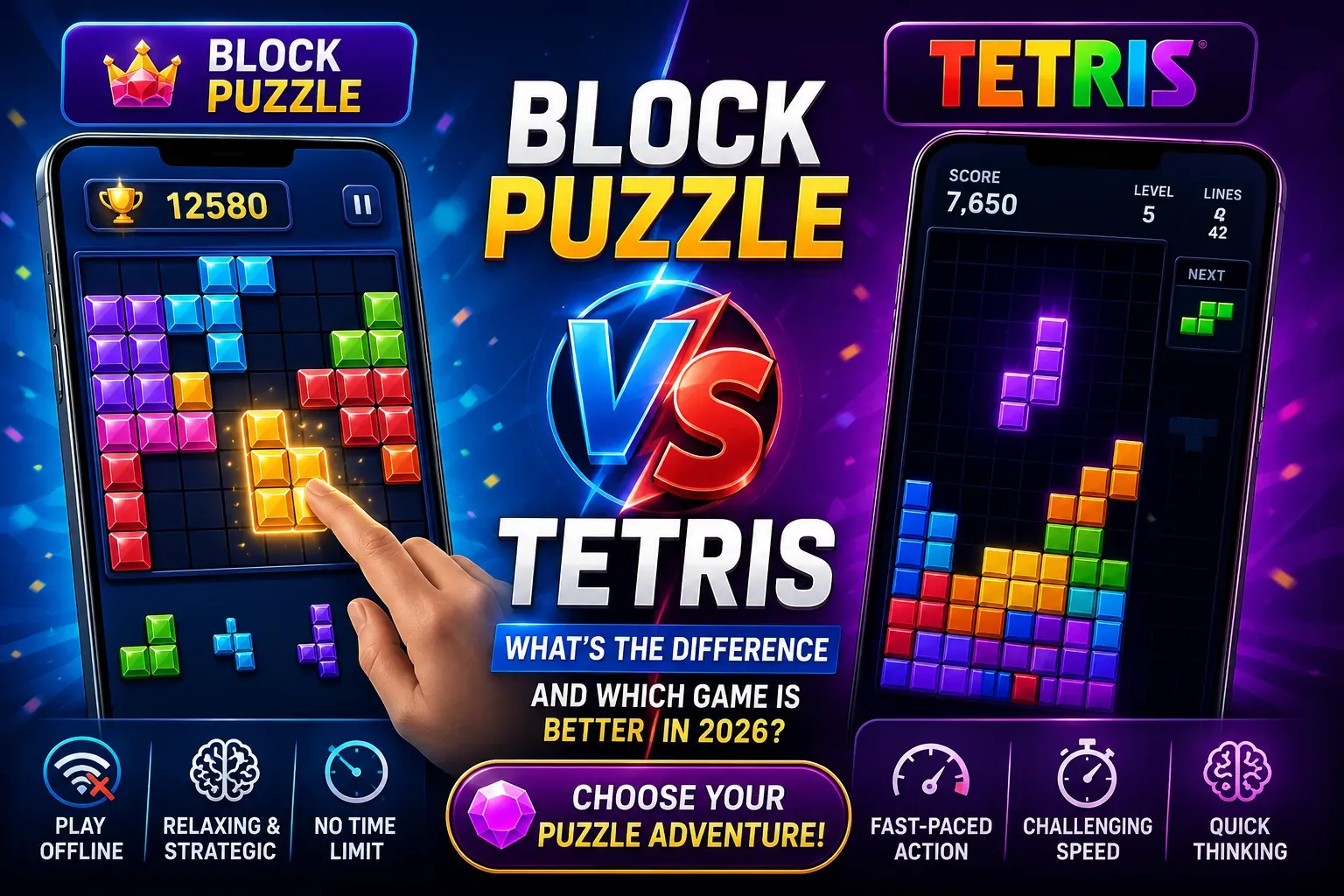
For decades, puzzle games have entertained millions of players worldwide. Among them, Tetris has earned legendary status, while Block Puzzle games have become one of the most downloaded mobile game genres in recent years. Because both games involve arranging blocks to clear lines, many people assume they're essentially the same. However, once you start playing, you'll quickly notice that the experience is surprisingly different.
Although both games challenge your strategic thinking and pattern recognition, they cater to different types of players. Tetris is built around speed, quick reactions, and fast decision-making, while Block Puzzle focuses on thoughtful planning, relaxing gameplay, and long-term strategy.
So, which game is better in 2026?
The answer depends on what you're looking for. In this guide, we'll compare Block Puzzle and Tetris across gameplay, difficulty, strategy, accessibility, and brain-training benefits to help you decide which puzzle game suits your style.
What Is a Block Puzzle Game?
A Block Puzzle game is a strategy-based puzzle game where players drag differently shaped blocks onto a board to complete rows or columns. Unlike falling-block games, there is no time pressure, allowing players to think carefully before making each move.
Modern Block Puzzle games are designed to be simple enough for beginners while remaining challenging for experienced players. Instead of reacting quickly, success comes from planning ahead, managing available space, and creating opportunities to clear multiple lines.
Most Block Puzzle games also include offline gameplay, making them ideal for relaxing anytime, anywhere.
What Is Tetris?
Tetris is a classic puzzle game where geometric blocks called tetrominoes continuously fall from the top of the screen. Players must rotate and position these pieces before they reach the bottom, clearing horizontal lines to keep the board from filling up.
Created in 1984, Tetris became one of the most influential video games in history. Its simple concept and increasingly fast gameplay have challenged generations of players.
Unlike Block Puzzle, Tetris rewards quick reactions just as much as strategic thinking.
Why People Often Confuse Block Puzzle and Tetris
At first glance, both games appear very similar.
Both involve placing blocks on a grid.
Both reward clearing complete lines.
Both become more challenging as the game progresses.
However, the similarities largely end there.
The biggest difference lies in how players interact with the board.
In Tetris, the game controls the pace by continuously dropping blocks.
In Block Puzzle, the player controls the pace completely.
This single difference changes the entire experience.
Block Puzzle vs Tetris: Key Differences
| Feature | Block Puzzle | Tetris |
|---|---|---|
| Block Movement | Drag and place anywhere | Falling blocks |
| Time Pressure | None | Continuous |
| Gameplay Style | Relaxed | Fast-paced |
| Learning Curve | Beginner-friendly | Moderate |
| Strategy | Long-term planning | Fast decision-making |
| Offline Play | Common | Depends on version |
| Session Length | Flexible | Often longer |
| Stress Level | Relaxing | More intense |
Although both games require logical thinking, they appeal to different types of players.
Gameplay: Planning vs Speed
Perhaps the biggest difference between the two games is pacing.
In Tetris, every second matters.
Blocks continue falling regardless of whether you've decided where to place them. As the game speeds up, players must think and react almost simultaneously.
This creates excitement, but it can also become stressful for casual players.
Block Puzzle takes a different approach.
There are no timers.
No falling pieces.
No pressure.
Players can study the board, consider multiple options, and choose the best move without rushing.
Because of this relaxed pace, Block Puzzle is often preferred by players who enjoy thoughtful strategy over quick reflexes.
Which Game Is Better for Relaxation?
If your goal is to unwind after work or enjoy a few peaceful minutes during the day, Block Puzzle is usually the better choice.
The absence of countdowns and time pressure creates a calm gaming experience.
You decide when to move.
You decide how long to think.
There is no penalty for taking your time.
Many players enjoy Block Puzzle before bed, during coffee breaks, or while traveling because it's easy to pick up and play for just a few minutes.
Tetris, while incredibly fun, naturally creates a greater sense of urgency because the falling blocks never stop.
For players seeking relaxation, Block Puzzle offers a more comfortable experience.
Which Game Offers Better Brain Training?
Both games provide excellent mental stimulation, but they challenge the brain in slightly different ways.
Tetris develops:
- Quick decision-making
- Hand-eye coordination
- Reaction speed
- Spatial reasoning
Block Puzzle strengthens:
- Strategic thinking
- Planning ahead
- Pattern recognition
- Problem-solving
- Working memory
Because there are no time constraints, Block Puzzle encourages deeper analysis of every move.
Players often spend more time evaluating possible outcomes, which helps develop long-term planning skills.
Both games exercise the brain, but they do so through different cognitive challenges.
Which Game Is Better for Beginners?
Someone completely new to puzzle games will usually find Block Puzzle easier to learn.
The controls are simple.
Drag.
Drop.
Play.
There is no pressure to rotate blocks quickly or react within seconds.
New players can experiment, learn from mistakes, and gradually develop better strategies.
Tetris has a steeper learning curve because beginners must simultaneously:
- Rotate pieces
- Position blocks
- React quickly
- Adapt to increasing speed
This makes Tetris rewarding but sometimes intimidating for first-time players.
For casual gamers and newcomers, Block Puzzle provides a smoother introduction to puzzle gaming.